

Proust and the Squid
It's official. You should be doing more of this

When I was five years old I did something that physically changed the structure of my brain. I wouldn’t call it an injury, but the result was that part of my brain originally used for visual processing moved elsewhere. I’m not a neuroscientist and I don’t know quite where it moved, but I do know the change was permanent and irreversible.
And if you’re reading this, it happened to you too.
I learnt to read.
We’ve been speaking and arguing with each other for about 130,000 years. But writing it all down is a recent innovation. It started about 5000 years ago and our brains haven’t had the evolutionary time to carve out a special area devoted to it. So every single person who learns to read has to go through the process of creating a brain space for reading. Neuroplasticity makes it possible and it’s evidence of the brain’s remarkable capabilities to learn anything.
Brain systems originally devoted to visual processing are packed up and reassembled in a new home. Connections are built between the new visual systems, auditory systems and language centre and it’s all complete before your 7th birthday.
For some it stops there, but it doesn’t have to and if you read Proust and the Squid: The Story and Science of the Reading Brain by Maryanne Wolf, you’ll find out how unfathomably an intricate and extraordinary process this is and how it can be developed further.
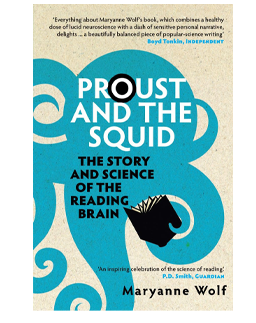
Published in 2008, I’d never heard of it until a friend sent me a copy a few weeks ago and it’s never been far from my reach since. Maryanne Wolf has dedicated most of her professional life to researching reading, how children learn to read and what can go wrong with conditions like dyslexia. Previously a professor at the Department for Child development at Tufts university, now a director at UCLA she also has a Master’s in English literature. And you can tell. She gives us a history of the evolution of language rich in fascinating facts. Reading is such an intrinsic part of my day, I hadn’t thought much about how writing evolved. Our ancestors spent thousands of years developing an alphabet capable of turning spoken language into words. The probable earliest complete alphabet was created by the ancient Greeks. Wolf discusses the positive feedback system of learning to read and then using writing to develop thought: the two skills together propelling thinking and human insight. Was it responsible for the explosion of ideas appearing at the time. Wolf argues it’s possible.
The book explores other themes about language learning, brain processes while reading and what happens in brains where learning to read is impaired.
If you have any interest in these subjects you’ll enjoy this book, but it might also make you fear for the future. Once you realize the essential role reading plays in brain development and the ability to think, you start to wonder what will happen in a future where more people choose to scroll. Where we use devices that are designed to hijack our attention, where reading is pushed aside to make way for the instant reward. AI powered social media platforms could win the intelligence race not by reaching superhuman levels of cognition, but by making us all stupid.
Last year I made two decisions: to dedicate one part of my day to exercise and another to reading. Instead of just fitting them in around other activities, they are now a feature. After reading Proust and the Squid I’m even more determined to ensure reading for pleasure has a central role in my day. Maybe I’ll finely get round to finishing In Search of Lost Time.